All posts by David Ritter

Ray Harryhausen Released the Kraken in 1938

Click the images in this post to see full-sized renderings.

June 29 2020 marks the centennial of the birth of Ray Harryhausen (June 29 1920 – May 7 2013), iconic pioneer (though not inventor) of stop-motion animation. Most science fiction fans are familiar with his filmography, which spans four decades (1942 – 1981).

As with many of the genre writers, artists, editors and publishers who became prominent in the 1940s and 1950s, Harryhausen’s first involvement with science fiction was fostered by organized fandom in the 1930s. He connected with the active fan community in Los Angeles and became an early member of the local chapter of Hugo Gernsback’s Science Fiction League.

In Harryhausen’s own words, from a 1998 conversation with David A. Kyle, recorded and transcribed by John L. Coker III:

“When I was young my mother bought for me a series of books called Wonder Books. They had wonderful illustrations and photographs of strange things such as Egyptian temples, and charts on how long it would take to go to the Moon and to Mars and all the different planets. That started to stimulate my interest in science fiction.”

The Wonder Books: The Earth Before Man (Janssen and Cole, University of Knowledge, Inc., 1940

“Then, I saw Metropolis and Just Imagine and The Golem, all when I was very young. They had a real influence on me. We teethed on Frankenstein and Dracula.

“The Golem,” 1920

“I didn’t know much about stop motion at the time when I saw The Lost World. King Kong was the one that did it. It sent me spinning out of Grummen’s Chinese in a tailspin. I haven’t been the same since. This big gorilla was responsible for introducing me to Fay Wray, Willis O’Brien and Forrest Ackerman. I owe a big debt to this gorilla, who was fifty feet high, sometimes forty feet, sometimes thirty feet. He was a big inspiration to me.”

King Kong Movie Herald, 1933

I was more interested in the visuals than the science fiction literature, such as the covers of Imagination that Forry [Ackerman] used to publish. The magazine covers for Wonder [Stories] and the artwork of Frank R. Paul were a stimulus.”

Imagination! (LASFL fanzine), v1n8, May 1938. Art by Hannes Bok

I became interested in Gustav Doré, and he was my mentor. He was a wonderful Victorian artist who was noted for his engravings, although he was a sculptor, an oil painter and many other things. I learned about Gustav Doré from Willis O’Brien.

Untitled, by Gustav Doré (1832 – 1883)

The Kraken debuts

More from Harryhausen’s conversation with David Kyle:

“In the mid-1930s when I was still in high school, Forry told me about the little brown room in Clifton’s Cafeteria where the Los Angeles chapter of the Science Fiction League would meet every Thursday. Members included Russ Hodgkins, Morojo, and T. Bruce Yerke. Robert Heinlein used to come around, and a guy named Bradbury. We were a group who liked the unusual. There was a fellow named Walt Daugherty, who was an anthropologist by trade, and a photographer. He would make presentations about Egyptology. Another young fellow named Ray Bradbury would arrive wearing roller skates. After selling newspapers on the street corner he would skate to meetings because he had no money. He used to go meet the stars at the Hollywood Theater where they did weekly radio broadcasts. Ray was writing for Forry’s magazine called Imagination. I did one of the covers for an issue, which was mimeographed.”

Ray Harryhausen’s cover illustration for Imagination!, v1n12, September 1938

You may be thinking: The Kraken, you say? But, The Kraken didn’t appear until Harryhausen’s 1981 classic “Clash of the Titans.” We submit that the evolution of The Kraken occurred in clear steps beginning with Harryhausen’s 1938 cover for Imagination! For example, in October 1942, Harryhausen rendered this cover for the Los Angeles Science Fantasy Society’s fanzine Voice of the Imagi-Nation.

Voice of the Imagi-Nation, n25, October 1942. From Fanac.org.

Perhaps imprisoned by the creative gods, The Kraken railed at the bars of its watery cage for fifteen years. But in Harryhausen’s 1957 film 20 Million Miles to Earth, this charming Kraken progenitor (or spawn) emerged:

The “Ymir” from “20 Million Miles to Earth,” 1957

And again, in The 7th Voyage of Sinbad from 1958, another Kraken ancestor (or descendant):

The Cyclops from “The 7th Voyage of Sinbad,” 1958

The creature Harryhausen originally conjured from his imagination in 1938 evolved over the decades, until at the height of his powers in 1981, the ultimate Kraken was released.

Harryhausen and his model for The Kraken from “Clash of the Titans,” 1980

How many times did Harryhausen see King Kong?

Fans had many opportunities to see the seminal 1933 icon of Willis O’Brien’s stop-motion animation, King Kong. After its original release, RKO distributed the film again in 1938, 1942, 1946, 1952 and 1956. Harryhausen was known to pursue these opportunities relentlessly.

In the Forward to Ray Harryhausen: An Illustrated Life (Ray Harryhausen and Tony Dalton, Aurum Press, 2003), Ray Bradbury wrote:

“My happiest memories are of Ray calling me during the years just out of high school and telling me that King Kong was playing somewhere, in some obscure theater in L.A., so we had to rush over and buy 15-cent seats to watch that glorious animal perform again…”

The count of Harryhausen’s viewings of King Kong became something of a legend within the Los Angeles fan community. Expanding reports appeared in fanzines of the period.

Imagination!, v1n9, June 1938. Twenty viewings!
Imagination!, v1n10, July 1938. Two more in just a month.
Ad Astra, v1n4, November 1939. Now up to 32 viewings.
Voice of the Imagi-Nation, n12, March 1941. At least one more viewing.
See below for the Popular Mechanics article.

Inspired by King Kong, Harryhausen began to experiment with animating his own models. Between 1938 and 1940, he filmed the ambitious short “Evolution,” featuring a dramatic Brontosaurus-versus-T-rex-versus-Triceratops battle. From his interview with David Kyle:

“I met [Willis O’Brien] when I was still in high school. He was my mentor. I noticed his name on King Kong, Son of Kong, and The Last Days of Pompeii. So, I called him up once at MGM when he was making War Eagles. He kindly invited me over to the studio.
“I brought over a suitcase full of my dinosaurs. I was particularly proud of a stegosaurus I had, for which I had won an award in an amateur contest at a local museum. I had made a diorama that I think won second prize. I was rather proud of it. He looked at it and said ‘Those legs look like sausages. You must learn to develop muscles. Every animal and every person has muscles to make the shape of the leg.’ I should have known this, but it was a shortcut. He said that I had to go to art school, so I went to high school during the day and went to art school three nights a week. USC started a course on film editing, photography and art direction and I signed up for it.”

A dinosaur diorama by Ray Harryhausen. From the collection of John L. Coker III
Popular Mechanics Magazine, April 1941

Harryhausen as mask-maker

FAN, n3, August 1945. The photo credit reads: “Rubberoid masque macabre fashioned by stf-reader & artist of LA, Sgt Ray Harryhausen,” who had by then enlisted to serve.

Harryhausen’s talent for model-making extended to masks. He contributed to the prankster culture in LA fandom by outfitting his fellow club members.

Futuria Fantasia, v1n2, Fall 1939
Forrest J Ackerman in Voice of the Imagi-Nation, n25, October 1942

Ackerman later recounted the tale of his award-winning Harryhausen mask in Space Cadet n12:

“Ray Harryhausen chaneyed me into ‘The HunchbAckerman of Notre Dame’ in 1941 and his effective mask won me a prize at the 3rdWorld Science Fiction Convention that year in Denver. He started out to make me an ‘Odd John’ mask – albino hair, bulging frontal lobes, and all, as described by Olaf Stapledon in his superman novel of the same name – but the mask somehow came to grief (after quite a bit of grief of my own, lying on my back in his backyard, breathing through my mouth, my face baking in a plaster mold he was making of it, while his great dog Kong padded around occasionally sniffing me or licking my feet); the odd john mask was not completed to Ray’s satisfaction by the time of my departure for Denver and so a substitution was made of the Hunchback mask which he had previously created. I could only hope that my teenage years were going to turn out as cool as his. (They didn’t.)”

Harryhausen’s early art

Harryhausen’s occasional illustrations for fanzines reflected his passions for dinosaurs and macabre creatures.

Voice of the Imagi-Nation, n20, January 1942. Collection of Sam McDonald
Voice of the Imagi-Nation, n16, July 1941. From Fanac.org

Happy birthday, Ray!

Ray Harryhausen and fellow-First Fan David A. Kyle, 1998. Photo by John L. Coker III

Ray Bradbury’s Clubhouse

FANS OF SCIENCE FICTION first flocked together in the 1930s. They connected through letters written to the magazines they cherished—Amazing Stories, Wonder Stories, Astounding Stories. They exchanged correspondence, formed groups and began to issue their own amateur publications. Prominent among the early clubs were chapters of the Science Fiction League (SFL), an association founded in 1934 by pioneering publisher Hugo Gernsback. Los Angeles became home for chapter #4 of the SFL (LASFL) in November 1934.

Shep’s Shop — a bookstore on Hollywood Boulevard — drew young fans hungry for science fiction. Used bookstores played a vital role in fueling young fans’ passion. They offered access to current and back issues of pulps, both the core genre organs and others such as Argosy, that periodically carried science fiction yarns. Pre-owned copies could often be acquired for as little as a nickel.

Imagination! v1n7, April 1938

Mikros, v1n2, October 1938

In 1937, among the eager young patrons of Shep’s was 17-year-old
Ray Bradbury. There he met members of the LASFL, was invited to join and first attended the club’s regular Thursday meeting on October 7. About this period, longtime Bradbury friend and fellow member T. Bruce Yerke wrote:

T. Bruce Yerke in “Memoirs of a Superfluous Fan,” May 1944

LASFL meetings convened at Clifton’s “Brookdale” Cafeteria, 648 South Broadway in Los Angeles. This establishment wasn’t what one might imagine from its name. Founded in 1931, Clifton’s has endured (with interruptions) as a Los Angeles landmark to modern times. Images from the 1930s portray something like a Disneyland of cafeterias. It was a venue with a purpose, openly promoting Christian faith and a generous philosophy that included the “Multi-Purpose Meal (MPM)”—priced at a nickel, but free to those who couldn’t pay.

Above: Clifton’s Brookdale Cafeteria, c1940
Below: “Views of Clifton’s,” a promotional brochure, c1940. Click the cross-arrows to expand.

By the late 1930s, Clifton’s was already a notable institution. At its peak, the restaurant could seat 15,000 people. Hunter Oatman-Stanford describes the venue’s unique, progressive model in a marvelous article in Collector’s Weekly:

“In the thick of the Depression, Clifford Clinton built his restaurant as a place of refuge for those unable to afford a hot meal (one of the neon signs out front read ‘PAY WHAT YOU WISH’). Soon after the first Clifton’s opened, customers began referring to it as the ‘Cafeteria of the Golden Rule.
Long before the Civil Rights movement allowed black Americans to freely patronize white-run establishments, Clifton’s restaurants were integrated. In response to a complaint about his progressive policy, Clinton wrote in his weekly newsletter, ‘If colored skin is a passport to death for our liberties, then it is a passport to Clifton’s.’ Regardless of income or skin color, Clinton wanted everyone who ate at his restaurants to be completely satisfied, so the phrase ‘Dine free unless delighted’ was printed on every check. Though many patrons ate for free, enough customers gave significantly more than they were asked to keep the business afloat.”

In contrast to the overall grandiosity of Clifton’s, the “little brown room” on the third floor, which hosted the LASFL’s Thursday meetings, was decidedly nondescript. In a wonderful 2009 interview with the National Trust for Historic Preservation, Bradbury described the LASFL meeting room:

There was nothing in there … When we met there on Thursdays, they’d put a double row of tables in the middle of the room, and twelvechairs on one side, twelve chairs on the other side. We sat facing each other. It was very social.”

In those days, Bradbury earned his living — about nine dollars a week — selling newspapers at the corner of Olympic and Norton in Los Angeles. In Surround Yourself With Your Loves and Live Forever, edited by John L. Coker III, Bradbury’s friend Ray Harryhausen later recalled:

“In the mid-1930s when I was still in high school, Forry told me about the little brown room in Clifton’s Cafeteria, where the Los Angeles chapter of the Science Fiction League would meet every Thursday. Robert Heinlein used to come around, and a guy named Ray Bradbury. We were a group who liked the unusual.
“Ray would arrive wearing roller skates. After selling newspapers on the street corner he would skate to the meetings because he had no money. He used to go meet the stars at the Hollywood Theater where they did weekly radio broadcasts.”

In later years, Bradbury recalled his involvement with the SFL in Tales of the Time Travelers: Adventures of Forrest J Ackerman and Julius Schwatrz, edited by John L. Coker III:

“I was in high school when I joined the Science Fiction League in October, 1937. I remember poking my head into the little brown room in Clifton’s Cafeteria. Forry invited me in and immediately gave me a job writing for his hectographed fan magazine Imagination. I did some terrible covers for it and I wrote some awful articles.”

Bradbury’s cover illustration for the March 1938 issue of Imagination! (v1n6)

Over the years, Bradbury and other LASFL alumni would periodically reunite at Clifton’s.

Forrest J Ackerman, Ray Harryhausen, Ray Bradbury, Walter J. Daugherty at Clifton’s, c1990.
Collection of John L. Coker III

Bradbury was inspired and mentored by fellow fans he met in the Little Brown Room — Robert Heinlein, Leigh Brackett, Henry Kuttner, Hannes Bok and others. Bradbury’s first science fiction writings appeared in the LASFL’s fanzines, including Imagination!, The Damn Thing, Sweetness and Light, and his self-published Futuria Fantasia. Many of these rare works can be found in The Earliest Bradbury, now available from First Fandom Experience

Robert A. Madle in 1930s Fandom

[Click the images in this post for improved readability.]

Robert A. Madle celebrated his 100th birthday on June 2, 2020. His life as an active fan began in 1935 and continues to the present. As one privileged to have visited with Bob and spelunked his legendary basement, on behalf of the FFE team I’m honored to present highlights from his first contributions to fandom.

(Photo c1938 from the collection of Robert A. Madle, courtesy of John L. Coker III)

Ted Ditky’s concise biography from 1940 only scratches the surface of Madle’s prominent role in early fandom. His consistent presence contributed to the stable and collegial atmosphere in the Philadelphia fan scene — a sharp contrast to the rancor rampant among fans in the New York area.

From Ted Ditky’s “Who’s Who in Fandom,” 1940

Madle’s first foray in fan publishing was the single issue of The Science Fiction Fan (February 1935), developed with his fellow-Philly friend and frequent collaborator John V. Baltadonis.

This title is not to be confused with the fanzine of the same name launched in 1936 by Olon F. Wiggins.

(From Fanac.org)

Philadelphia fans (left to right) Jack Agnew, John V. Baltadonis, Robert A. Madle, c1935.
From the collection of Robert A. Madle, courtesy of John L. Coker III

Like many of his contemporaries, Madle was an active correspondent and regularly offered his views to the professional pulp magazines that he read religiously. Below are some of his earliest, from Pirate Stories (July 1935), Amazing Stories (August 1935), Weird Tales (December 1935) and Astounding Stories (February 1936). In a 2006 conversation with John L. Coker III, Madle recalled:

“My very first letter appeared in the July 1935 Pirate Stories.  I was a Gernsback fan, and anything he published I picked up.  I read his editorial in the first issue.  He said that they will publish pirate stories of the past, the present, and yes, even of the future.  So, I wrote a letter saying that they ought to publish a novel about a space pirate and they should get Edmond Hamilton to write it.  They printed the letter and I won a year’s subscription to Wonder Stories.  I was fourteen years old and I thought that this was one of the greatest things that ever happened.”

Madle’s second-ever letter to a magazine at age 15 demonstrates that he had already begun his nine-decade career as a dealer in science fiction.

Madle and Baltadonis made their next fanzine attempt with Imaginative Fiction in October 1935. According to the Pavlat & Evans fanzine index, there were only two copies of the two issues created by the duo.

On the back cover of the second issue of Imaginative Fiction, we find the first glimmers of the most-indelibly-famous perennial listing of Bob’s collection and want list — The Amazing Madle Catalogue.

As early as October 1936, Madle was offering advice to other aspiring collectors of science fiction.

Madle’s short story “Devolution,” originally published in Imaginative Fiction v1n2, was reprinted in C. Hamilton Bloomer’s Tesseract, v1n5, November 1936.

After a pause, Imaginative Fiction was rebooted in June 1937 with v1n3, which included a short article by Madle. The run totaled five issues, the last appearing in July 1938.

On October 22 1936, Madle joined fellow fans from Philadelphia and New York in an impromptu gathering that Donald Wollheim declared to be the “First Science Fiction Convention.”

Attendees at the October 1936 First Eastern Science Fiction Convention.
Left to right: Oswald Train, Donald A. Wollheim, Milton A. Rothman, Frederik Pohl, John B. Michel, William S. Sykora, David A. Kyle, Robert A. Madle.
Photo by Herbert E. Goudket, from the collection of John L. Coker III.

Also in October 1936, Madle led a cadre of Philadelphia fans in publishing Fantasy Fiction Telegram. This digest-sized zine featured content from contributors beyond the Philly sphere, including Donald Wollheim of New York and Duane Rimel of Washington State. The fifth and last issue was published in June 1938.

In the final issue of Fantasy Fiction Telegram, Madle offered his defense of science fiction and fandom.

Fantasy Fiction Telegram, v1n5, June 1938

In July 1937, Madle began contributing a regular news and gossip column, “Fantaglimmerings,” to John Baltadonis’ prominent fanzine, The Science Fiction Collector.

Madle’s role as Director of the Philadelphia Science Fiction Society (PSFS) was honored in the first issue of PSFS News in November 1937. The PSFS has survived through the decades and remains active today.

The biography continued in the next issue of PSFS News (v1n2, December 11 1937).

Madle’s next publishing venture, Fantascience Digest, first saw print in December 1937. The fifteen-issue run continued until December 1941.

Ad for Fantascience Digest, distributed to the Fantasy Amateur Press Association (FAPA), March 1939

In the first issue of Mark Reinsberg’s Ad Astra, Madle celebrated science fiction’s emergence into the mainstream in 1938.

Madle was an active attendee at the first World Science Fiction Convention in New York in July 1939, meeting prominent professional authors…

Robert A. Madle and Manly Wade Wellman, July 1939 at the first World Science Fiction Convention in New York.
Photo by Conrad H. Ruppert, from the collection of John L. Coker III

…adventuring with fellow fans from across the country…

SF Fans at Coney Island, NY (July 4, 1939), on a side expedition from the 1939 World Science Fiction Convention.
Rear – V. Kidwell, Robert A. Madle, Erle M. Korshak, Ray Bradbury. Front – Mark Reinsberg, Jack Agnew, Ross Rocklynne.
Collection of Robert A. Madle, courtesy of John L. Coker III

…and manning first base for the PSFS Panthers at the first ever fan convention softball game, July 4 1939.

New Fandom, v1n6, January 1940

In Ad Astra v1n3, September 1939, Madle shared his some highlights from his experience at the WorldCon.

In November 1939, Madle penned an impassioned endorsement of Philadelphia fandom and its gatherings. This set the stage for the Fourth Annual Philadelphia Conference.

Later that same month, Madle welcomed his fellow fans to the 1939 Philadelphia Conference, extending the yearly tradition that continues today.

PSFS News, v2n3, November 1939. This issue served as the program for the conference.

A sizable book would be required to give full justice to Bob’s 1930s legacy. He wrote extensively for his own fanzines and others’. We’ll add additional artifacts and observations as we dig them up and sort out the gems. Perhaps said book will emerge spontaneously from this thread.

Thanks to John L. Coker III, Sam McDonald, Doug Ellis and Fanac.org for their vital contributions to this post.

Happy 100th birthday, Bob!

A Rarity: Tellus News

This issue of Tellus News, a “newspaper of the future,” was discovered among a collection of fanzines from the 1940s.  It was mis-categorized because of the cover date: “Sol 23, 1947”

But this hand-drawn fanzine was created in 1932 by Howard Lowe as a vision of what news might look like 15 years hence.  It’s not a copy — it’s an original set of drawings. Rendered in colored pencil, it was likely never reproduced, and as such is a one-of-a-kind artwork.

The Pavlat-Evans Fanzine Index cites Forrest J Ackerman’s claim that Lowe produced “About 15 issues, ‘32 – ’33.”

We’ve found no further information on Lowe or his work, and would appreciate any insight anyone can offer.

Use the crossed-arrow icon to view the pages in full-screen.

“The Friendly Magazine”

The fanzine Sweetness and Light was launched in Spring 1939 by the “Moonrakers,” a clique within the Los Angeles Science Fiction League. The Editorial Board consisted of Russ Hodgkins, Fred Shroyer, Henry Kuttner, Jim Mooney and Art Barnes. The subtitle proclaimed the publication to be “The Friendly Magazine.” Like all of its contents over its five-issue run, the masthead was ironic.

Sweetness and Light, v1n1, Spring 1939

Chambers’s Twentieth Century Dictionary of the English Language notes: Moon′-rak′er, a silly person
Moon′-rak′ing, the following of crazy fancies

And so they were, and so they did.

Each issue prominently featured outlandish cartoons by Jim Mooney, the cutting wit of Henry Kuttner and morose and / or sarcastic offerings from Fred Shroyer.

The editors collaborated on a series of caricatures that today’s fans deserve to see. Shroyer provided most of the prose, with Kuttner taking at least one turn. Some appear to target specific prominent fans of the day, while others seem more archetypal.

Our question: Are things really that different these days?

Some fans of the 1930s developed a fascination with Communism, some active in the Communist Party until Stalin made it less fashionable.
Sweetness and Light, v1n1, Spring 1939
Sweetness and Light, v1n2, Summer 1939
Russ Hodgkins or T. Bruce Yerke, perhaps.
Sweetness and Light, v1n2, Summer 1939
A reference to Forrest J Ackerman, no doubt — and the others who emulated his abuse of language.
Sweetness and Light, v1n2, Summer 1939
Oklahoma fan Jack Speer was suspected of harboring Fascist sympathies, which he outgrew.
Sweetness and Light, v1n3, Fall 1939
Hannes Bok, perhaps — or the artist Mooney himself?
Sweetness and Light, v1n3, Fall 1939
West Coast fans generally had equal disdain for the various warring fan factions of New York.
Sweetness and Light, v1n3, Fall 1939
Seems to be a mashup of Donald A. Wollheim and John B. Michel.
Sweetness and Light, v1n4, Winter 1940
Most likely alludes to Harry Warner, Jr., editor of Horizons.
Sweetness and Light, v1n4, Winter 1940
Sweetness and Light, v2n1, Spring 1940
Images from this issue are from the Coslet-Sapienza Fantasy and Science Fiction Fanzine Collection, University of Maryland, Baltimore County
Sweetness and Light, v2n1, Spring 1940

‘Nuff said.

A Visit To Science Fiction House

From the papers of Donald A. Wollheim

This is the first in a series of posts that will surface unpublished articles and fiction by Donald Wollheim. These come from a set of papers recently acquired from Lloyd Currey, who sourced them from the Wollheim estate. The provenance appears clear and the content consistent with his other writings of the period.

The notion of a “Science Fiction House” emerged in New York fandom in the late 1930s, and first became real with the establishment of a residence in Brooklyn known as Futurian House. The story of that fabled abode is told in detail in the October 1939 and January 1940 issues of the Jim Avery’s M.S.A. Bulletin, the club organ of the Maine Scientifiction Association. (Full reproductions of that account are found in The Visual History of Science Fiction Fandom.) Given the ages and largely unemployed status of its residents, it’s not too surprising that the story reads a bit like an early draft script for Animal House.

Frederik Pohl in Science Fiction News Letter, v2n14, September 1 1938

But Wollheim had already formed a vision of an idyllic communal living space for fans. This fictional history, sadly incomplete, is dated December 3 1937. (Click the images for full-screen renderings.)

Neil Young comes to mind:

“Oh to live on Sugar Mountain
With the barkers and the colored balloons…”

We can all wish for such a place, these days.

The Earliest Bradbury

In honor of the upcoming centenary of Ray Bradbury’s birth (August 22, 2020), we’re digging through our archive of 1930s fan material to find the earliest appearances of Ray’s writings — in any form. We hope to publish a compendium of these in the next several weeks.

We’re not talking about the well-known and oft-reproduced works such as Futuria Fantasia, or even the somewhat-known and occasionally-reproduced “Hollerbochen’s Dilemma.” We’re seeking anything that appeared prior to 1940 that has rarely surfaced, especially as it was originally printed.

A primary source for Ray’s earliest articles is the Los Angeles Science Fiction League’s organ, Imagination! This zine’s first issue was published in October 1937 — the same month that Ray joined the LASFL. It ran for thirteen issues through October 1938. Through years of ardent questing, we’re fortunate to have assembled a complete run.

There are several items in Imagination! that are explicitly ascribed to Bradbury. We’ll be reproducing all of these. Some are satirical essays, the first of which was printed in v1n7, April 1938.
[Click any of the images to see a more readable full-page rendering.]

All well and good for the work he signed. However, we’re in a quandary over four pieces that we believe could be Bradbury’s, but were published under a variety of pseudonyms or are confusingly attributed.

For example, this page from v1n2, November 1937:

This is the first time Bradbury’s name appears in Imagination! However, we weren’t confident that the signature applied to the entire piece. Based on information from Donn Albright — kindly passed on by Jonathan R. Eller at the Center for Ray Bradbury Studies at Indiana University – Purdue University Indianapolis (which is perhaps the coolest thing in the world) — it appears that Bradbury is the author of the article.

This is especially important to sort out because a similar attempt-at-humor appears in v1n1, October 1937.

Scan from the University of California Riverside Special Collections

And in v1n3, December 1937, we find this little unpolished gem.

(Our copy of this issue was originally mailed to Litterio B. (‘Larry’) Farsaci, so the comment in pencil is likely his.)

If one of these spoofy bits was penned by Bradbury, it’s likely that they all were. The seems at least somewhat consistent with other contributions. In considering this, don’t be too distracted by the clipping of words as Ackerman made famous — Bradbury is known to have emulated this elsewhere; e.g. in the verse below from v1n9, June 1938.

One further candidate for Bradbury attribution is this charming ditty from v1n11, August 1938.

The bottom of the page is signed by Bradbury, but “Dead Reckoning” and the associated art at the top are not attributed.

We’d be most appreciative if any Bradbury or LASFL scholars could offer additional insight on these mysteries.

Palmer’s Ascension: A True Story From Early Fandom

Raymond A. Palmer began his pioneering work in science fiction fandom in 1928 at age 18. In 1938, his amateur accomplishments as a club organizer, fanzine publisher, author, editor and promoter of science fiction launched his professional career when he became editor of the iconic pulp magazine Amazing Stories. This is his story, an excerpt from The Visual History of Science Fiction Fandom, Volume One: The 1930s.

Art by Mark Wheatley (Breathtaker, Doctor Cthulittle, Song of Giants).
Click the crossed-arrows for a full-screen view!

You can read more about Palmer’s early adventures as a leading fan at The Cosmos Project. His full life story is told in engaging fashion in “The Man From Mars: Ray Palmer’s Amazing Pulp Journey” by Fred Nadis (Tarcher-Perigee, 2013).

Our sources for this narrative comic include Harry Warner’s “All Our Yesterdays,” which recounts the timeline of Palmer’s first day at Amazing Stories. Also informing the text is an article Palmer penned that appeared in Stardust, v2n2, November 1940. From here we get Ray’s triumphant quote at achieving his position as editor:

“You can imagine how I felt. Here at last I had it in my power to do to my old hobby what I had always had the driving desire to do to it. I had in my hands the power to change, to destroy, to create, to remake, at my own discretion.”

In his autobiography “Man of Two Worlds,” Julius Schwartz related how he came to use Palmer’s name as the real-life moniker of DC Comic’s The Atom:

“An accident had damaged [Palmer’s] spine when he was a youngster, so Ray never was able to grow to full adult height… So I called up Ray and asked his permission to appropriate his name for the civilian identity of the new Atom, and he graciously assented. (An added bonus of the call was that it inspired me to come up with one of the Atom’s unique powers, where he could travel from place to place along the phone lines as if he was one of the transmitted sound particles.)”

A Very Mysterious Photograph

Among the surviving papers of John V. Baltadonis, prominent First Fan of the Philadelphia persuasion, is this odd little photograph.

From the collection of Steve Baltadonis

I say “little” because the print is perhaps 1″ x 2″.

Recent spelunking revealed an appearance in the Program Book for the Fifth World Science Fiction Convention, held from August 30 through September 1, 1947, in Philadelphia (“The PhilCon”).

The photo was found next to other snapshots that appear to date from 1939 or 1940. An additional clue on the date is that the robot appears to be astride the cover of an issue of Charles D. Hornig’s Science Fiction, which ran from March 1939 through September 1941.

Please let us know if you have an insight that can further identify this peculiar piece of fan ephemera.

Also, just for fun, here’s an early William Rotsler cartoon from the same PhilCon Program Book, which found its way to us via Dave Kurzman and John L. Coker III.

In 1939, Lithography Came To Fanzines — But Why?

Print quality mattered in early science fiction fanzines. The credibility of the editors and authors was projected by the appearance of their publications — and this sometimes translated into professional opportunities. Access to a printing press in the 1930s was a luxury most couldn’t afford.

Beginning in 1932, Conrad H. Ruppert reshaped the world of fan publications with the printing press he bought with money saved by working in his father’s bakery. He printed issues of the most prominent fanzines of the period, including The Time Traveller, Science Fiction Digest, and Charles D. Hornig’s The Fantasy Fan. It’s not unreasonable to assert that the professional appearance of Hornig’s leaflet-sized ‘zine contributed to his ascension to the editorship of Wonder Stories at the age of 17. (You can read much more about Conrad H. Ruppert here.)

Without a friend like Ruppert, fans were limited to the only only affordable means of duplication at the time — the hectograph and the mimeograph. Both were limited in the quality and detail of reproduction. Many fanzine experimented with both, as seen in the evolution of Walter E. Marconette’s Scienti-Snaps.

But in early 1939, a new printing technology — lithography — began to radically transform the look and feel of fanzines. I say ‘new,’ because we haven’t seen any examples of this technique used in fan publications prior to 1939.

Lithography was invented in the late 1700s, when slabs of limestone were inscribed with grease pencil and rolled with ink. Rotary offset lithography using metal plates was developed in 1875. Technology for Photostats, an early version of photographic reproduction, was developed in the early 1900s.

In 1939, Larry Farsaci was an active fan and a founding member of the Fantasy Amateur Press Association (FAPA). In the March FAPA mailing that year (#7), he included a single-sheet lithographed image. This is the earliest example we’ve seen in fan-produced material.

Lithographed image by Larry Farsaci, March 1939, FAPA mailing #7

The difference in clarity and resolution between this litho image and previous hecto or mimeo reproductions is immediately evident. Later in 1939, Fantasy News published a lithographed image on its cover. Ad Astra followed suit in its January 1940 issue with an image described as a “planograph.”

In 1940 and 1941, the first fully-lithographed fanzines appeared. A notable example is the successor to Scienti-Snaps, Marconette’s Bizarre.

Another ambitious example, the “semi-professional” magazine Stardust, edited by William Lawrence Hamling.

Stardust, v1n1, March 1940

Fanzines using lithography gave the publications a step-function upgrade in attractiveness and readability. Great! But it’s not like lithography was new to the world. The question we’re working to answer is: What changed that made it possible for fanzines to utilize this method of printing?

  • Did the cost of lithography (aka offset printing) significantly decline, perhaps due to some technical innovation?
  • Did fans have more money to spend? Possible, since the Great Depression had largely abated.
  • Was there a “Conrad H. Ruppert of lithography?” Marconette gives credit to the staff of Stardust for assistance in the production of Bizarre.

After substantial digging and help from a number of printing historians, we’ve been able to stitch together a strong hypothesis for this transition. The primary factor appears to be the growing availability of low-cost, easy-to-operate offset lithography equipment through the mid-1930s and early 1940s. Other developments also likely contributed, including new “photo-resist” (light-sensitive) coatings for creating lithograph plates via photography.

A major clue was provided by Walter J. Daugherty’s fanzine Fan, number 7, March 1946. The issue was dedicated to a single article titled “How to Print an Amateur Paper.” We sourced our copy from two collectors: John L. Coker III provided a partial copy that led us to the material, and Sam McDonald was able to supply the critical pages that refer specifically to offset lithography.

Fan, n7, March 1946, edited by Walter J. Daugherty

From this we know that by 1946 offset photo-lithography was available in “all large cities” at reasonable rates — $3 in 1946 translates to about $42 today. Most fanzines had circulations well below 300.

One word in this article led us to a key insight: “Multilith.” This isn’t a generic term for a printing technology. It’s a brand name, and refers to a line of offset printing presses manufactured by the Addressograph-Multigraph Corporation of Cleveland, Ohio (hereinafter AM).

This company is a fascinating case study of a firm that prospered during the Great Depression, at least in part by continuing to invest in research and development. From their annual reports, we can see their introduction of a series of offset presses that were central to the more general and affordable availability of lithography.

In 1933, AM patented and introduced the Multilith Model 1227, likely the first office-sized, electrically-powered offset printhead.

Addressograph-Multigraph Corporation’s Multilith Model 1227
From the 1933 Annual Report of the Addressograph-Multigraph Corporation

In 1938, AM reported that the Multilith had become a substantial part of their business — an indication that this equipment was reaching a wider audience.

From the 1938 Annual Report of the Addressograph-Multigraph Corporation

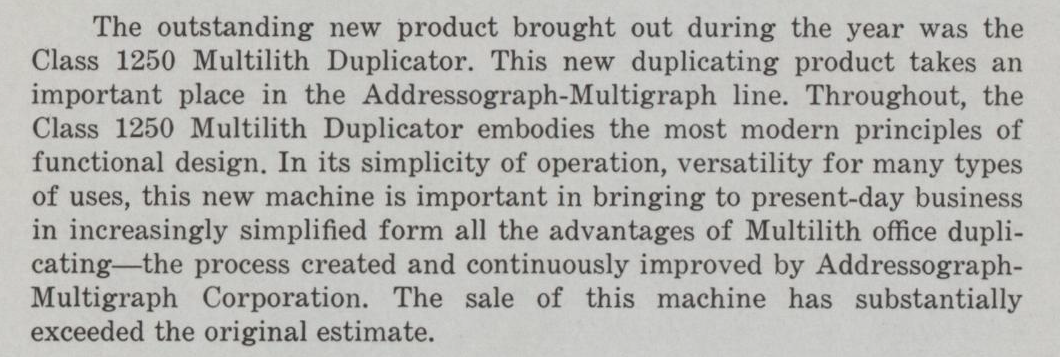
In 1941, AM advanced this product line with the introduction of the Multilith Model 1250. This press and its namesake successors appear to have dominated small-shop and office lithography for the next few decades. Some of these machines are still in use today.

From the 1941 Annual Report of the Addressograph-Multigraph Corporation
Addressograph-Multigraph Corporation’s Multilith Model 1250

This is almost certainly the model of offset press referred to in the 1946 article.

By 1939, the First Fans were mostly young adults. Some had jobs (though many did not) and so were in a position to take advantage of this superior and now-accessible printing technology. The ability to easily replicate finely-detailed originals through photography enabled new levels of artistic expression. It seems apparent that these factors came together in the late 1930s to spur a dramatic advance in fan publishing.