…and from First Fandom Experience. We wish all a safe and joyous holiday season.


…and from First Fandom Experience. We wish all a safe and joyous holiday season.
In some ways, early science fiction fandom was like a family. Think Leave It To Beaver meets Jersey Shore. The love and hate in the complex web of relationships often played out both in person and in fanzines. A shining example: a 1938 late-night road trip worthy of Scorsese’s After Hours.
In February 1938, Samuel A. Moskowitz penned a saccharin homage to his brothers and occasional sister in the fan community. “They’re Grand” appeared in The Science Fiction Fan (v2n6).


Little did Sam expect that his open embrace would be taken by some as an open door. The very next month, certain intrepid fans embarked on an epic soiree, as described in Richard Wilson’s The S-F Dividend (n2, distributed with the April 2 1938 issue of The Science Fiction News Letter). It’s also a delightful tour of the New York Area public transportation system of the day.


Seems Moskowitz might not have been overjoyed at the pre-dawn intrusion. In the March-April 1938 issue of The Science Fiction Collector (v3n6), he posted a somewhat evolved view of his fannish comrades under the (sadly faded) title, “They’re Grand, But They Have Their Faults.”


It’s not completely clear that Sam is referring here to the March 13 home invasion, but it seems likely. The “perverted brain” is pretty clearly the arch-nemesis Donald A. Wollheim.
Of course Richard Wilson wasn’t going to let this stand. He responded in the June-July issue of The Science Fiction Collector (v4n2).

Text transcribed below.
Sam Apologizes – By Proxy
by Richard Wilson, Jr.
This is written to set at ease the minds of Milton Rothman, Oliver Saari and any other who were apologized by the article, or a part of it, written by Sam Moskowitz: “They’re Grand — But They Have Their Faults.” The question most frequently asked seems to be: “Who were the two drunks that visited Mr. Moskowitz’ Newark that fatal night?” The question as such, cannot be answered. No inebriated individuals visited the Home of Helios that night — or rather, morning. Two stf fans undertook the perilous journey that day. But they weren’t drunk. They may have been crazy, but they weren’t cozzled. I should know; I was one of them. Jack Gillespie was the other. And why didn’t Samuel give our names? Self-defense, most likely. So that, should we become indignant and sue, he could smile ingratiatingly and say, oilily, “Why, I wasn’t referring to you boys. Heaven forbid! I was talking about two other fellows.” You know the gag,
Nor was it our fault we arrived so late — or early as you will. We left N.Y. at a reasonable hour; midnight or so, I think it was. The blame should be laid at the door, or doors, of the many transportation co.s to be found between Manhattan and Newark: ferries, railroads, tubes and taxis.
Let this serve to absolve G. Hahn of all suspicion of being an occasional, or otherwise, tippler. When the much discussed incident took place, George was, more than likely, at home (in Buffalo, or whatever the name of the place is) tossing Noddish sheep over fences.
Sic transit gloria mundi! And on Sunday mornings, too.
George R. Hahn appears to be the fifteen-year-old fan in question, a seemingly precocious lad who’s credited with publishing his own fanzine as early as 1936 at age 13 (The Asteroid (II), per Pavlat & Evans). He had a brief run as a professional writer beginning with the January 1939 publication of “The Fifth Candle” in Weird Tales (as Cyril Mand, per isfdb.org).
Interesting that we find this obscure reference in Fancyclopedia:
(Hahn, je crois; Dockweiler called it the New Science Fiction Special) – “At about four-thirty ack emma, while leering a trifle crookedly at the murals, Harry got The Idea. Why not a Rummy’s Stf Special? After a little thought, and some help from his fellow sot and Jack [the bartender], he decided upon the concoction. # He simply took the old, well-known gin-and-ginger ale, and added a touch of bitters. # Now, lean close. Fill a Tall Glass — not completely, you yap, unless you think you’re good – half gin, the rest ginger ale. Then, a dash of bitters …. Two drinks had Harry (who detests Efjay) admitting that Forrest might not be such a bad guy after all. A couple more and he went off on a crying jag over an old, lost love of his.” — From an unpublished manuscript by Harry Dockweiler, written probably in 1937.
Since the inception of the institution in 1938, the spontaneous all-nighter remains a fannish tradition to this day. Anyone that’s stayed at a hotel hosting a science fiction convention and attempted to sleep can attest to this based on the all-hours and boisterous hallway traffic outside their door.
Thus passes the glory of the world… of fandom.

We have the word “experience” in the name of our project for a reason. We’re hoping to bring early fandom to life in a more visceral, accessible and interactive way than previous histories of the period. To that end, we’re always searching for examples of what fans of the 1930s did when they weren’t slaving over a typewriter, mimeograph machine or steaming vat of hectography gelatin.
One thing some of them did is eat ice cream. Not remarkable in itself, but we’d assume that hard-core science fiction fanatics would find a way to make dessert a part of their primary fixation.
As we can see from this article by future-Futurian Frederik Pohl in the The International Observer (v2n7, January 1937), we know that they did just that.


Donald A. Wollheim and John B. Michel published an enhanced and refined version of the recipe in The Science Fiction Bugle, May 1937.


We’re tempted to believe the stain on the Bugle is chocolate sauce from 1937. Untangling the references:
In an interview with John L. Coker III, David Kyle recalled this treat as a regular feature of meetings of the International Scientific Association, one of the warring fan-factions of New York at the time:
“I went to a meeting of the ISA and there I met Donald Wollheim, Fred Pohl, Dick Wilson, John Michel, and a few others who came a little later, like Robert W. Lowndes, Chester Cohen, and Cyril Kornbluth. After the meeting, which was on a Sunday, we did what all young guys did in those years: we went to a soda fountain. Somebody said that they wanted certain flavors, with nuts and a cherry, custom-made by the ice cream shop. It was called the ‘Science Fiction Sundae.’ It was a small store and we went there regularly. You didn’t have to go through a routine of the ingredients, we’d just ask for it by name.”

This promotion for the fans’ favorite soda shop appeared in the fanzine Arcturus (v1n3, February 1936). Fanzine editors sometimes convinced local business to run ads — likely with little return on the marketing investment.
Records of K. Pivoroff’s Brooklyn establishment appear to be lost. From newspapers of the day, we know that 880 New Lots Avenue was occupied by a Funeral Home.
We also know that the East New York Science Fiction League — Chapter #3, formed in June 1935 — had its headquarters just down the street from Pivoroff’s.

Be on the lookout at upcoming conferences for a “Science Fiction Special” ice cream event sponsored by First Fandom Experience!

In May 1937, John W. Campbell, Jr. was looking for work. He was in good company — the unemployment rate in the United States was fluctuating around 15%, reflecting the lingering economic malaise of the Great Depression. Despite his degree in Physics and some success as a writer of science fiction stories, Campbell hadn’t found a steady gig.
This was to change in the Fall of that year when Campbell was hired as the Editor of Astounding Stories, where he reigned until his death in 1971. His Wikipedia entry describes his subsequent impact on science fiction:
“Referring to his time spent as an editor, The Encyclopedia of Science Fiction wrote: ‘More than any other individual, he helped to shape modern sf. Isaac Asimov called Campbell ‘the most powerful force in science fiction ever’ and said the ‘first ten years of his editorship he dominated the field completely.’ In his capacity as an editor, Campbell published some of the very earliest work, and helped shape the careers, of virtually every important sf author to debut between 1938 and 1946, including Robert A. Heinlein, Theodore Sturgeon, Isaac Asimov, and Arthur C. Clarke.”
As a tribute to Campbell, in 1973 the World Science Fiction Society established the “John W. Campbell Award for Best New Writer.” This prize has been awarded yearly ever since — until Tuesday, August 27, 2019.
The award still exists, but on that day was renamed the “Astounding Award for Best New Writer.” As reported in the New York Times and elsewhere, this shift was driven by renewed attention to Campbell’s well-known, publicly-expressed racism. Jeanette Ng, winner of the 2019 Best New Writer prize, called out Campbell to cheers from the audience:
“John W. Campbell, for whom this award was named, was a fucking fascist. Through his editorial control of Astounding Science Fiction, he is responsible for setting a tone of science fiction that still haunts the genre to this day. Sterile. Male. White. Exalting in the ambitions of imperialists and colonisers, settlers and industrialists. Yes, I am aware there are exceptions.”
As we seek to tell the story of science fiction fandom in the 1930s and 1940s, repugnant attitudes among early fans and professionals are impossible to miss, should not be missed, and should not be dismissed or ignored. By documenting this period in what some might deem a celebratory way, we’re in no sense endorsing these views — nor will we shy away from them.
Through our research, we have an opportunity to share insight into Campbell’s life prior to his work at Astounding. The letter presented here in full was penned by Campbell on May 15 1937, several months before he was hired as an editor. The recipient, Robert D. Swisher, was himself a research chemist and early science fiction fan. Swisher and Campbell corresponded regularly through the 1930s and 40s. It’s presented here by expressed permission from Perry A. Chapdelaine Sr., who acquired the letter from the Campbell estate. The San Diego State University watermark isn’t original to the letter — it’s an artifact of the archive where many of Campbell’s letters are physically stored. We appreciate the assistance of Alec Nevala-Lee and Doug Ellis in sourcing and establishing the provenance of this document.
Notes and my perspective on the content of the letter follows each page. Click the individual pages to view them in full resolution.


The vital role played by Mort Weisinger in launching Capmbell’s career as an editor demonstrates the vivid connection between fandom and the pros. Fanzines such as Weisinger’s Science Fiction Digest and Charles D. Hornig’s The Fantasy Fan served as the Grapefruit League for the draft class of professional editors recruited by the pulps in the mid 1930s. Weisinger’s relationship with Campbell was further brought to life by Julius Schwartz in an interview with John L. Coker III:
Before he became an editor, John W. Campbell used to write science fiction, what is referred to today as hard science fiction, much in the vein of “Doc” Smith stories. He tried to broaden his market, so he submitted stories to Mort Weisinger, but Mort rejected them. Finally, Campbell says, “Mort, what is wrong with my stories? Why aren’t I writing the type of stories you’re looking for?” Mort says, “You’re writing the type of scientific stories that I don’t want to bore the readers with. I want you to get to where you’re going, tell an exciting adventure story, and don’t load it down with too much science fact.” Campbell says, “I’d like to take a chance on it. Can you give me an idea what style I should use?” So Mort says, “My favorite writer is Stanley G. Weinbaum.” They were human interest stories. They were believable. Campbell read the stories of Stanley G. Weinbaum, and he submitted a story and Mort bought it. Campbell was very happy and he started writing a series of stories along the same line.
The issue came out with the first story in it, and Campbell went up to see Mort. Campbell says, “Mort, what did you do to the story that appears in the current issue?” Mort says, “I’m an editor, I get paid to edit, so I edited it.” Campbell says, “Does that mean you can change the title of a story of a script that I sell you?” Mort says, “Of course, if I don’t like the title I change it to a title that I like, or something that I think will appeal to my young readers.” Campbell said, “You mean you can take the title of a story you bought and change the title?” Mort said, “Yeah, didn’t you look at the back of the check? It says we can edit and make it suitable for publication.” Mort said, “I cut out the dull parts and got into the action.” I don’t remember the title of the story that Campbell had, but Mort changed it to “The Brain Stealers of Mars.” Any young person must read a story entitled “The Brain Stealers of Mars,” even a few of you adults would want to read a story like that. [Campbell’s original title was ‘Imitation.’ We have to agree that Weisinger’s title is a more likely hook. – dhr]
Campbell said, “I didn’t know you could do that. Let me ask you a few more questions. Why did you change so much of my copy?” Mort says, “John, I told you that I didn’t want to be burdened with your science facts. Get to Mars, don’t tell me how much oxygen there is or isn’t. Let’s get to the story and the damsel in distress. Let everything roll. Get the action going. So, I put that stuff in there for you. I have to do it. Leo Margulies, the editorial director, looks over all our scripts to make sure we’re earning our money, so there’s plenty of rewriting.”
Mort asked him if he had any other problems he wanted to hit him with. Campbell said, “I don’t think that it was the world’s greatest illustration. Those stories had illustrations to excite the reader to read it.” Campbell asked, “How is the selection made for the artist to draw?” Mort said, “I give the artist the story to read, pick out an exciting scene. I will write a description and give it to the artist, and he will draw the story as I instruct him to do.”
Campbell asked Mort, “After you edit the story, and make all the corrections, what do you do with it?” He said, “Send it to the printer so he can set it up in linotype. When we get it back we proof-read it for typographical errors.” Campbell said, “I know your magazine has one hundred sixty pages. How do you make it come out even?” Mort said, “That’s the easiest part of all. All you have to do is put in all of the stories and ads for one hundred fifty two pages, then put in eight pages of letters, and you get one hundred sixty pages.”
John W. Campbell patted Mort Weisinger on the shoulder and said, “I want to thank you very much for these instructions, and I want you to be the first to know. I’ve just been made the editor of Astounding Stories and I didn’t know what an editor does. Thanks to you, I know.”
I told that story when Fred Pohl was present and he said, “No, that’s not true. Mort told a lie. All John W. Campbell did was go to Leo Margulies and Margulies told him exactly what to do.”
Campbell’s letter appears to support Schwartz’s version of events.
The current intense discussion of Campbell’s definitive influence and his deep personal flaws should continue. We hope this contribution adds to the beautiful bonfire.
I’ll say at the start that this is about as obscure as it gets in spelunking fan history. Sometimes we have to ask ourselves if we’re exploring the fringe of the fringe of the fringe, and if anybody will care. We’re sitting in a metaphorical hole in an allegorical desert with an analogous toothbrush, attempting to discern if the illustrative grey lump we’re delicately brushing at is an ancient pot… or an ancestor’s bone… or… ya, crap… it’s just a rock. In this case, we think what we’ve unearthed is at least a pretty cool rock.
If you subscribed to Fantasy Magazine in 1934 and anxiously tore open the February issue that had just landed in your mailbox, you might have been excited to see that it included the next chapter of Cosmos, the ambitious serial novel orchestrated by Raymond A. Palmer and the staff. This installment was number nine of seventeen, penned by Abner J. Gelula. Menace of the Automoton revealed the rise of a race of domineering robots on Earth. It drew its heritage from Gelula’s first published story, Automoton, that appeared in the November 1931 issue of Amazing Stories.


This whole Cosmos thing was a pretty remarkable stunt for the mostly-teenaged editors to pull off. The relationships they established with professional writers through this effort would serve them well later in life. But getting it done wasn’t easy. They weren’t paying for the chapters, and some of the authors didn’t meet their commitments. For example, in the December 1933 issue of Science Fiction Digest, Palmer announced:
“With this writing comes the sad word that Miles J. Breuer is confined to a sanatarium, with a nervous breakdown from overwork. This means that the doctor, loved by all science fiction fans, will not be able to write his part for COSMOS.
This is certainly a great loss to the super-serial COSMOS, and to us, who love his writings, and we will have no time to replace him with a writer equaling him in reputation, but we have secured the services of Miss Rae Winters, who wrote “The Girl from Venus” and its sequel, which you will read in this magazine in the near future. Miss Rae Winters shows extreme promise and I am sure she will develop into a fine writer.“
“Miss Rae Winters” was unsurprisingly a pseudonym for Palmer himself. He’d stepped in to write the chapter that perhaps had driven Breuer to madness. A great risk and sacrifice! And a shameless self-promotion.
Anyway. If you read the rest of the February 1934 issue, you’d eventually come to page 30 and the regular column titled “The Editor Broadcasts.” This was ostensibly penned by Conrad H. Ruppert, but could have been written by anyone on the staff. Oddly, the first paragraph of the column was crudely redacted in black ink.

A mystery! Something had occurred between printing and publication that simply had to be erased. The few tantalizing letters visible at the end weren’t enough to give even a hint.
We’re delighted and relieved to report that this troubling gap in the historical record has now been plugged. In a copy of this issue bound into a volume for Palmer, we see a version of this page where the redaction is transparent enough to allow it to be read.

If you don’t want to squint, it says:
“For some unexplained reason Abner J. Gelula failed to send in his chapter to COSMOS. Repeated letters and postcards have brought forth no reply. We are very sorry that our readers must again be disappointed and trust that you will enjoy Wallace Wray Quitman’s offering, which is being introduced in place of the part originally scheduled for Mr. Gelula.”
We can only guess that the promised chapter arrived just in time to be printed separately and bound with the issue. We can also surmise the identity of “Wallace Wray Quitman.” If Palmer ever actually wrote the replacement chapter, it has likely been lost to history. If it turns up, we’ll be sure to share it.
You can read more than you’ve ever wanted to know about Cosmos at The Cosmos Project.
Coming soon from First Fandom Experience are facsimile volumes reprinting the full runs of Science Fiction Digest, Fantasy Magazine and the Cosmos inserts. You can read more about that here.
This post is work-in-progress. We’re developing this content for inclusion an upcoming volume of The Visual History of Science Fiction Fandom. Feedback and leads on additional material pertinent to the Second Eastern Con are much appreciated!

The second-ever “science fiction convention” in the United States occurred on February 21, 1937 in New York City. There is of course the endless debate about what really constituted a “convention” versus just a gathering of fans. The “First Eastern Con” occurred in October 1936 in Philadelphia. It was an informal afternoon attended by perhaps a dozen fans from the East Coast, from which there are no known printed artifacts. The idea for a more formal get-together in New York was hatched at that meeting.
The planned New York gathering claimed the lofty “convention” moniker and was organized by the core of the New York Branch of The International Scientific Association (NYBISA). This cadre — Donald A. Wollheim, John B. Michel, David A. Kyle and Fredrik G. Pohl — would play central roles in the drama and shenanigans surrounding science fiction clubs and confabs for the next several years.
The program for the convention is a small, delicate leaflet, elegant if terse.

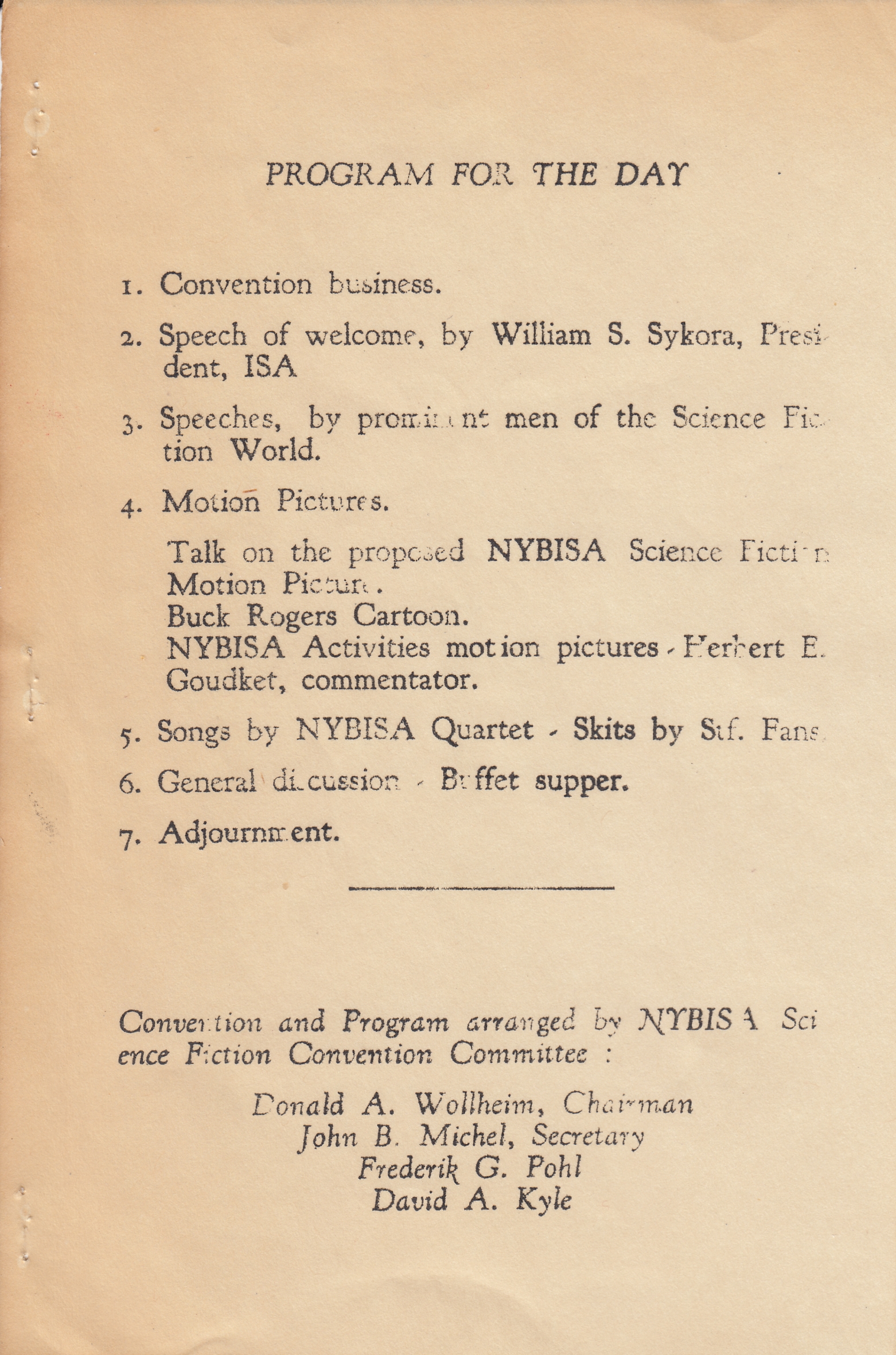
Songs? Indeed, songs. As remembered by Robert A. Madle in a conversation with John L. Coker III:
“The ISA had a bunch of songs, and one went like this:
Oh, we’ll rally from the nuthouse,
We’ll gather from the cell,
Shouting an accolade to Gernsback.
To cheer for dear old Wonder
And the good old SFL,
Shouting an accolade to Gernsback.
The SFL forever, let rockets light her way,
Shouting an accolade to Gernsback.
With C.D.H. to lead us
Through commentary hell,
Shouting an accolade to Gernsback.
Many of the ISA members hated anyone who was connected with Wonder Stories, including Charles D. Hornig. There were a lot of other people that they had picturesque names for. They referred to Forry Ackerman as Farwest J Sapperman, Sam Moskowitz as The Newark Neanderthal, James Taurasi was Il Duce of Flushing Flats, and The Philadelphia Science Fiction Society was known as the PSFS Hoodlums.”
Who was there on that somewhat musical day? We have one remarkable survival that gives us some evidence. The first issue of the fanzine Phantastique was produced by Burton duMont with a cover date of November 1936. The issue was actually distributed in January 1937, just in time for the convention. Our best guess is that someone brought a copy of this issue to the meeting and had it signed by many of the attendees.

This is the earliest collection of fan signatures that we’ve seen. Here are the names we’ve been able to decipher (top-to-bottom, left-to-right):
Arthur Leeds
Morris Chakamsky
Robert W. Lowndes
Conrad H. Ruppert
Charles D. Hornig X-ED (ex-editor?)
John J. Weir
Mort Weisinger
George R. Hahn (Curly)
Warren D. Woolsey
Willis Conover, Jr.
Richard Wilson, Jr.
John B. Michel
John V. Baltadonis
Walter Kubilius ISA
Robert A. Madle
Otto O. Binder
Julius Schwartz
Charles Schneeman
John V. Baltadonis (again)
Comparing this roster to the Second Eastern Convention attendee list from Fancyclopedia, there’s clear overlap and no obvious conflicts that would cause us to reconsider the origin of this piece. We’d be very interested to hear any other interpretations or evidence.
Sad to say, it appears that the “proposed NYBISA Science Fiction Motion Picture” was never produced.
Much of the history of fandom would have been lost long ago if many fans had not also been fanatical collectors. We see evidence of this everywhere in their writings from the 1930s. Almost every fanzine had a column for posting “wants” and offers to sell or trade for missing issues. Here are just a few examples of how fans stocked their libraries.

Forrest J Ackerman was notorious for the intensity of his collecting. Here we see a posting from Ackerman that appeared in The Brooklyn Daily Eagle from November 1, 1931. Forrest was just shy of his 15th birthday and lived in San Francisco, California.
How did young Forrest discover this obscure East Coast newspaper swap column? It seems his extended family was actively supporting his interests. See below from the November 8, 1931 issue of The Brooklyn Daily Eagle. (Thanks to Bill Mullins for digging up this letter.)

It didn’t take long for Ackerman to become known as a go-to person for other fans who hoped to find scarce items. Lester Anderson wrote to Forrest on April 24, 1933 with both an offer and a request.

Reading and collecting science fiction wasn’t without controversy. Apparently one female fan felt the need to seek spousal permission before pursuing her interest.

Many fans strove to assemble complete sets of the professional science fiction magazines, and to preserve them. In the first issue of Morris Scott Dollens’ The Science Fiction Collector, the editor offered advice on binding magazines for inclusion in a library.

The Science Fiction Collector from July 22, 1936 contained a fairly typical advertising section.

The publishers of fanzines also avidly followed and collected the work of their peers. Here Richard Wilson, Jr., notable for his long-running fanzine The Science Fiction News Letter, sought to fill gaps in his collection by tapping the usual suspect.

This led later in the 1930s to the creation of ‘zines fully dedicated to trading and collecting. Some were simple listings, such as Bob Tucker’s Science and Fantasy Advertiser. The first issue (titled The Science Fiction Advertiser) appeared in October 1938.


The care and dedication of these early collectors has made it possible for today’s fans to encounter the work of the earliest fans. One notable example: Walter A. Coslet of Helena, Montana. Coslet bought, sold and traded science fiction material of all types beginning in the early 1940s. The library he amassed has become a key resource for historians through the archival work of the Coslet-Sapienza Fantasy and Science Fiction Fanzine Collection held by the University of Maryland, Baltimore County. From The Kay-Mar Trader of March, 1947, we can see some of Coslet’s offerings to his fellow fans. This copy appears to be annotated by its owner to highlight their haves and wants.


The First Fandom Experience lapel pin has become our de facto logo. We needed a logo for our Windy City launch. We had the pin. Lacking any further inspiration and running out of time, the pin was it.

We didn’t invent the pin. It’s derived from a very relevant piece of science fiction fan history. Props go to Hugo Gernsback, Charles D. Hornig, and the staff of Wonder Stories in 1934 when the Science Fiction League was launched. The distinctive spaceship design was used as the League’s insignia…

…and appeared on the club’s membership pin. This original from the 1930s – a rare survival – is in the collection of Doug Ellis.

The pin was offered to members for 35 cents – close to $7 in today’s money.
In the depths of the Great Depression, we’re not sure that anyone ever sprang for the $2.50 solid gold version.
The original image for the insignia was based on an iconic Frank R. Paul cover from Science Wonder Quarterly, Fall 1929.

Our adapted facsimile was designed by Alison Scott of Stow Shirts,
Walthamstow, London. Alison was great to work with and also facilitated the manufacturing. You can see her reproduction of the original pin in her Etsy store.
We award FFE pins to friends, family and good folks who help us to spread the word about our project. Look for us at a science fiction, fantasy, or comic book convention soon!
On April 10 and 11 Daniel, Kate and I are spending time with Doug Ellis and Deb Fulton at their home outside of Chicago. The Windy City convention starts tomorrow, but Doug has graciously agreed to let us spelunk his archive of correspondence and other material from the estate of Jack Darrow (nee Clifford Kornoelje). Darrow was one of the most active early fans and central to activity in Chicago in the late 1920s and 1930s. The letters he exchanged with Otto Binder, William Dellenback and others gives a great sense of what it was like to be a leading fan during those seminal years.
On this post we’ll highlight just a few of the unique items we found in these files. Much, much more to come as we have a chance to process and post.


First Fandom Experience is a collaborative effort. It’s my privilege to introduce the people who make it possible.
My name is David Ritter and I live in Cambridge, Massachusetts. FFE is my second adventure in publishing related to science fiction in the 1930s. The first was The Cosmos Project. You can read more about my background there.
I encountered the somewhat legendary and quite peculiar round-robin novel Cosmos in my quest to find all of the original material written by E.E. “Doc” Smith. I blame Smith’s Lensman series as a primary instigator of my own fandom when I discovered it at (of course) age 12. Cosmos was orchestrated and published by a small cadre of science fiction fans who convinced an impressive set of professional writers to contribute. Smith wrote a chapter of the serial that was later re-published as a stand-alone story.
As my interest in fan history grew, I was fortunate to meet Dave Kurzman. Dave is a leading collector and dealer in science fiction ephemera. I’ll always thank him for many things, including his willingness to part with his copy of Weird Tales #2. I think he regrets it to this day. Through Dave I came into possession of a complete run of Science Fiction Digest and Fantasy Magazine, including all of the chapters of Cosmos.
The way Cosmos came together in the early 1930s is a microcosm of the overall phenomenon of organized fandom during that decade. The ambitious youngsters behind this grab-bag of a novel went on to found and largely dominate the science fiction genre for the next several decades. Their energy and optimism was infectious even as it reached across the intervening ninety years. My exploration of this era has been something of an obsession ever since. I submit re-typing all seventeen chapters of Cosmos as evidence.
Once The Cosmos Project was largely complete, I continued to explore the broader arc of fan history. This led me to what’s considered the canonical narrative of early fandom: The Immortal Storm by Sam Moskowitz. Moskowitz captured the stories of many of the key people and events of the early years from his own first-person experience and with his own distinctive perspective.
It was all well and good to read about all of the clubs, publications and gatherings that bootstrapped the science fiction industry. But it was also unsatisfying. I felt like I was reading a biography of Heinrich Schliemann, the archaeologist who discovered the ruins of the ancient city of Troy. I wanted to dig in the dirt myself, touch the very walls, walk the very sands where Achilles spilt the blood of Hector. Hence I started to seek out more of the original material created by folks who have come to be known as the “First Fans.”
Among many other places, this quest led me to the basement of Robert A. Madle in Rockville, Maryland. Bob was a prominent fan in the Philadelphia area beginning in the early 1930s and has since become a legendary collector and dealer in the field. I’m honored that he entrusted me to give a good home to his original copies of The Planet and The Time Traveller, seminal early fan publications without which any coverage of this era would be sorely incomplete.
Part of my commitment to Bob was the idea that I’d find ways to preserve and make these rare artifacts more widely available. At the time, there were only vague notions of how this might come about.
I’d been toying with the idea of creating a facsimile edition of Cosmos, patterned after the chapter inserts from its original publication. At the Windy City Pulp and Paper Convention in 2017, I kicked this idea around with Doug Ellis, the founder and organizer of the show. Doug is a prominent collector and publisher of several volumes of science fiction and pulp art. I also spoke with John L. Coker III, then President and Archivist of the First Fandom organization. John has done more to preserve and honor the memories of the First Fans than anyone through his various writing and publishing projects. He had been a contributor to The Cosmos Project, educating me and providing great material highlighting the key role of Conrad H. Ruppert and his printing press. It was John who suggested that perhaps more of the original fanzines from the early days could be brought out as facsimiles. This was the inception of First Fandom Experience.
Initially, I imagined that full facsimile runs of the key fan publications from the 1930s might be produced. Thanks to Doug for convincing me that this was impractical, if not entirely insane. Over the next few months and through many discussions, the alternate concept of a “visual history” of the period gradually formed.
At about this same time, I began to understand that anything approaching a robust visual treatment of early fandom would be a pretty massive job, and that trying to do it as a part-time hobby would likely take many years. So, for better or worse I suggested to my middle son Daniel that he quit his job and join the project on a full-time basis. When we look back on this in the future, I hope he thanks me for this. Time will tell.
Nepotism aside, Daniel represents a core component of the intended audience for our work: younger science fiction fans who so far have no notion that organized fandom existed in the dark past, that many of the masters of the genre started as fans way back then, and that their generation did not, in fact, invent cosplay. Kids these days should be interested in this history, darn it!
Nepotism further aside, Daniel brings a terrific base of relevant experience to this work. After graduating from Champlain College with a degree in writing, he served for five years as a writer, editor, staff lead and operations manager for a web content company. I’m delighted that he’s embraced the role of Managing Editor.
John L. Coker III has continued to be a committed member of the FFE team. His personal knowledge and interactions with the First Fans offer our most direct connection to these remarkable — and sometimes problematic — people. I’m sad that my interest came only after most of these pioneers had passed. John knew them, chronicled their lives and captured their memories. The interviews, notes and photographs he’s contributed are the most vital part of bringing this story to life. With his kind permission, the artifacts his contributions will feature prominently in FFE material.
Through John, we reached out to the First Fandom community to let them know about FFE. One of the immediate respondents was Sam McDonald. Sam brings deep knowledge and intense enthusiasm regarding early fanzines to the project. His own massive collection fanzine will play an important role in our publications. But Sam’s most remarkable contribution to FFE is the work he’s done and continues to identify sources for fan material, perform archaeology on a wide range of library and private collections, and catalog and index the content. His first blog post here reflects the richness and detail of his work, for which we are deeply grateful. He is the most extraordinary maker of lists that I have ever encountered.
In addition to his valuable advice, Doug Ellis has made available his extensive archive of correspondence and other material related to early fandom in Chicago. The active community there spawned such prominent fans as Raymond A. Palmer, Jack Darrow, Walter Dennis and Erle M. Korshak.
More recently, leading London-based fan historian Rob Hansen has joined our team as a Principal Historian. Rob’s definitive work on fandom in the UK, Los Angeles and elsewhere can be found in his site:
ROB HANSEN’S FAN STUFF
To Daniel, John, Sam, Rob and Doug — tremendous thanks for launching and sustaining this project. It would not be possible without an exceptional team and I can’t imagine a better one. To others, please let us know if you’d like to contribute as well. The FAQ provides an overview of the project. This site will hopefully grow over time to reflect the fascinating experiences of the early fans who gave first breath to the vast networks of science fiction communities that we know today.